
A game by Kestrel Kinetics
Cyber Bully 502 Bad Gateway
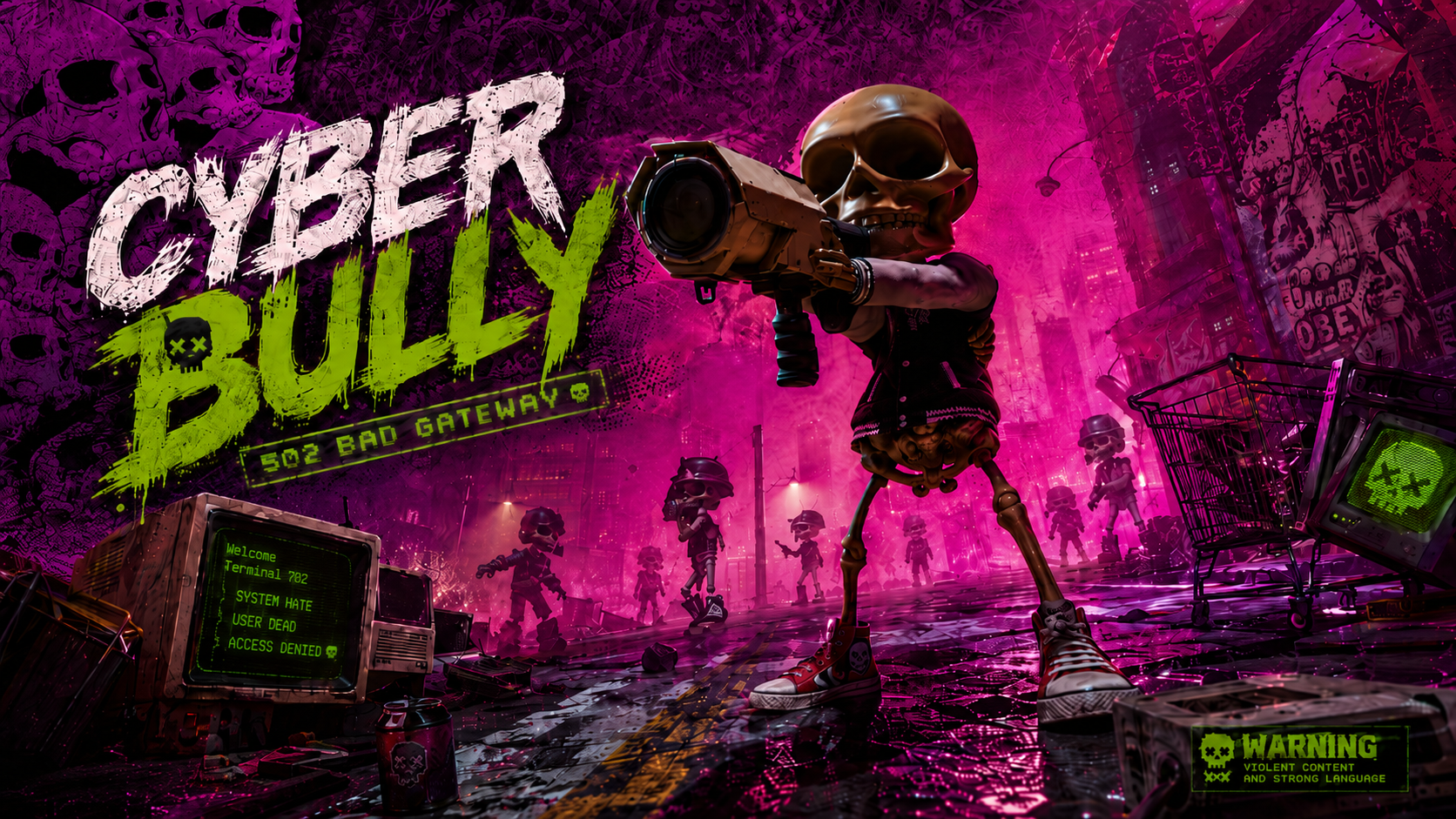
A retro-future action game set in Earth's final hours. Move through Low Haven, a dying mega city still running on obsolete war machines.
The game
The world is already ending.
Cyber Bully: 502 Bad Gateway is a retro futuristic action game about surviving Low Haven, a semi-procedural mega city in the last hours of Earth. You play as one of the final augmented soldiers, kept moving by failing body systems while hostile machines, ruined streets, and a dead war close in around you.
The game mixes fast combat with a collapsing urban maze: read the streets, push through machine patrols, and keep moving before your own systems give out. Because Low Haven's streets, patrols, and dead ends are semi-procedurally assembled, no two runs lay the city out quite the same way, so every playthrough is a different fight to survive.
Visuals
Explore the Systems of Low Haven.
Cyber Bully combines procedural world generation, extensive customisation, interactive terminals and reactive characters to create a city that changes between playthroughs. Its major gameplay systems are developed through a research-informed process, with features designed not only for play, but also for formal investigation and future academic publication.
Loading image feed...
A Procedural Mega City
Low Haven is built using a semi-procedural city generation system that creates changing streets, districts, buildings and routes.
Each playthrough produces a different version of the city, with new layouts, combat spaces, shortcuts, dead ends and areas to explore. The city maintains a consistent visual identity while ensuring that players do not follow exactly the same path every time.
Procedural generation is used to create variety without making the environment feel random or disconnected. Roads, structures and districts are assembled according to defined rules so that the city remains readable, believable and suitable for exploration and combat.
Thousands of Customisation Options
Cyber Bully includes thousands of possible armour, equipment and item combinations.
Players can combine individual armour pieces, clothing, weapons and utility items to create a character and loadout that reflects their preferred appearance and style of play.
Customisation is designed as more than a simple selection of complete outfits. Individual components can be mixed and matched, allowing players to build visually distinct characters from a large modular collection of items.
Interactive Terminal Systems
Terminals are integrated throughout Low Haven and form part of the game world rather than existing only as menu screens.
Players can use terminals to access information, communications, records, security systems and environmental controls. Some terminals may reveal details about a location, provide access to restricted areas or expose information connected to the people who lived and worked there.
The terminal system also supports environmental storytelling, allowing players to discover information through interaction rather than relying entirely on cutscenes or direct exposition.
Reactive NPCs
NPCs respond to the player, nearby events and changes within the environment.
Their behaviour can vary depending on what they witness, how the player approaches them and what has already happened during the playthrough. This allows characters to feel connected to the world rather than functioning only as static quest markers or background decoration.
Player actions may influence how NPCs communicate, behave or respond during later encounters.
Every NPC Has a Story
Each NPC has their own identity, background and place within Low Haven.
Their stories can be discovered through conversations, terminals, environmental details and events within the city. Some stories may be encountered directly, while others require the player to connect information found across different locations.
These individual narratives are intended to make the population of Low Haven feel like people with their own experiences, rather than interchangeable characters placed only to support gameplay objectives.
A Different Experience Every Time
The procedural city, reactive NPCs, terminal systems and extensive customisation work together to create variation between playthroughs.
Different routes, characters, discoveries, equipment combinations and encounters allow each run to produce its own version of Low Haven.
The objective is not to generate random content for its own sake, but to create a game world that remains structured while allowing players to experience it differently each time.
Research-Informed Development
Cyber Bully is developed through an academic research-informed design process.
Features such as procedural city generation, reactive characters, interactive terminal systems and modular customisation are implemented as both gameplay mechanics and subjects for formal investigation.
The development of these systems contributes to ongoing and future academic publications examining their design, implementation and evaluation.
This allows Cyber Bully to function not only as an entertainment experience, but also as a practical research platform for exploring new approaches to game design, procedural environments, player interaction and interactive storytelling.
Browse all screenshots
Press kit
Quick facts
- Game
- Cyber Bully: 502 Bad Gateway
- Genre
- Retro futuristic action
- Steam
- Wishlist page coming soon
- Status
- In development
Development log
Progress, without the noise.
Reading the commit history...
- Last 30 days
- 0
- Active days
- 0
- Longest streak
- 0
- Busiest day
- 0
Loading the Cyber Bully development history.
Syncing development log...